

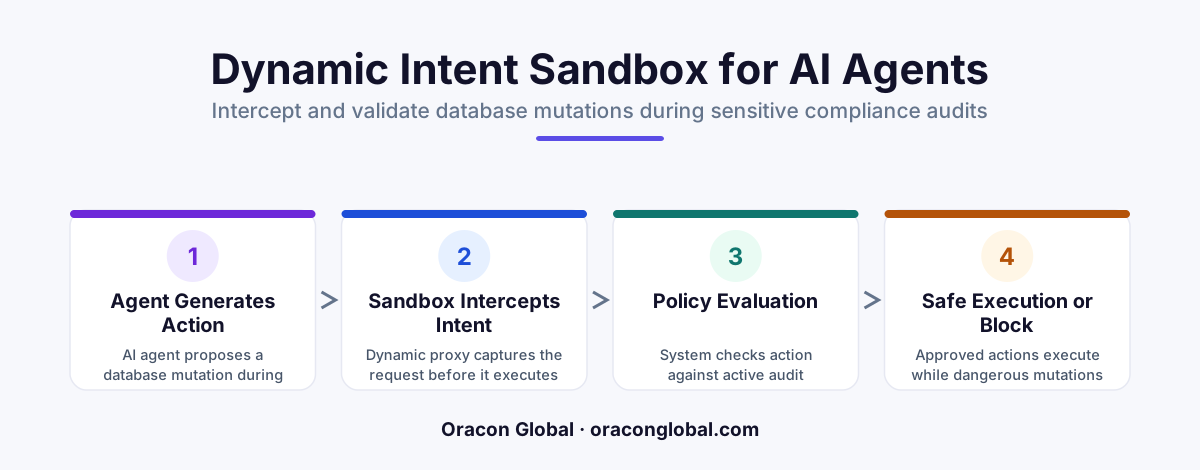
When compliance auditors review your databases, autonomous AI agents running routine tasks pose a hidden risk by writing, updating, or deleting records. A dynamic intent sandbox solves this by sitting between your AI framework and production database, instantly converting all incoming write requests into isolated, read-only evaluation states during sensitive audit windows.
When enterprise systems bring in compliance auditors to review historical records, SOC 2 controls, or financial ledgers, the underlying databases must remain trustworthy. Historically, this meant locking down human developer access and freezing code deployments. Today, however, modern infrastructure increasingly relies on autonomous AI agents to handle routine background tasks—reconciling accounts, updating inventory levels, and tagging customer records continuously.
This automated activity creates a critical liability. If an AI agent attempts an uncoordinated database mutation mid-audit, it can alter historical data trails, trigger schema locks, or introduce unverified state changes. To protect system integrity without turning off your automated workflows, engineering teams need a dynamic intent sandbox to safely isolate agent operations during high-risk evaluation windows.
The Risk of Autonomous Database Mutations During Audits
Autonomous agents operate by observing triggers, forming execution plans, and issuing API calls or SQL transactions. Under standard operating conditions, these automated writes streamline operations. During an official audit, however, uncontrolled background updates introduce major compliance challenges:
- Loss of Audit Reproducibility: Auditors sampling records need static targets. An agent overwriting rows during an active investigation corrupts sample consistency.
- False Regulatory Flags: AI agents modifying compliance-tagged tables can accidentally wipe historical metadata required by frameworks like HIPAA, GDPR, or ISO 27001.
- Lock Collisions and Timeouts: High-volume AI writes running concurrently with heavy audit queries cause table locks, slowing down both human auditors and automated systems.
Relying on system prompts to tell an LLM "do not update records today" is ineffective. Prompts are non-deterministic suggestions, not security controls. Database safety requires hardcoded infrastructural enforcement.
What Is a Dynamic Intent Sandbox?
A dynamic intent sandbox is a transactional proxy layer positioned between your agent execution framework and your production data stores. Instead of allowing an AI agent to issue raw INSERT, UPDATE, or DELETE queries directly to live tables, the sandbox intercepts every execution request.
During normal operations, the gateway validates payload structure and executes the query. When a high-risk compliance flag is active, the sandbox dynamically switches the execution mode:
- Payload Interception: The sandbox catches the agent's proposed action payload before it hits the production database engine.
- Intent Evaluation: The system inspects the operation type, target tables, and user context to determine if the write violates active audit policies.
- State Simulation: Rather than executing the change or failing silently, the sandbox mirrors the query against an isolated ephemeral database state.
- Diff Generation: The agent receives a successful mock response, allowing its internal logic chain to finish, while the proposed change is logged into a review queue for human sign-off.
Core Architectural Components
Building an enterprise-grade sandbox requires three primary layers designed for low latency and zero data leakage.
1. The Real-Time Policy Router
The policy router acts as the control plane. It reads global environment flags—such as AUDIT_MODE_ACTIVE = TRUE—along with table-level restriction rules. When an audit begins, an operator toggles the target scope (for example, freezing all changes to billing ledgers while leaving public knowledge base updates open).
2. The Ephemeral Isolation Layer
To keep the AI agent from breaking mid-task due to unexpected database errors, the sandbox simulates success. Using localized, lightweight in-memory databases or copy-on-write database replicas, the agent executes its intended mutation in isolation. It receives realistic response payloads, headers, and execution times without modifying live production disk storage.
3. The Human-in-the-Loop Review Buffer
Mutations blocked during an audit window are not discarded. Instead, the raw payload, agent rationale, and timestamp are committed to an isolated audit buffer table. Once compliance auditors complete their review, system administrators can inspect the staged changes, batch-approve valid operations, or discard problematic writes with a single click.
Implementing Safe Permission Controls for Enterprise AI
Deploying safe AI infrastructure is fundamentally an engineering discipline, not a prompt writing exercise. To protect core business software from autonomous drift during audit cycles, organizations must enforce strict boundaries:
- Enforce Read-Only Database Roles: Provide background AI workers with database credentials restricted purely to
SELECTpermissions by default, escalating write capabilities only through temporary, tokenized gateways. - Isolate State Management: Use local SQLite caches or dedicated state stores so agents remember short-term context without using production tables as scratchpads.
- Maintain Cryptographic Audit Logs: Ensure every intercepted agent request is hashed and stored in append-only logs, giving auditors clear proof of system compliance.
By shifting safety logic from language model prompts to deterministic software middleware, operations teams gain total control over when, where, and how AI digital employees touch core systems.
Build Safe, Enterprise-Grade AI Infrastructure
At Oracon Global, our senior in-house development team designs and ships custom software built for production requirements. From autonomous AI agents and AI-native ERP integrations to robust web and mobile applications, we engineer systems with deterministic guardrails, zero-trust permission models, and clean architectures. Best of all, our clients maintain 100 percent ownership of all custom source code and intellectual property.
If you are looking to deploy reliable AI workflows without putting your database security or compliance stance at risk, let's talk about your project today.
Frequently asked questions
What is a dynamic intent sandbox for AI agents?
It is an architectural safety layer that intercepts write requests from autonomous AI agents, evaluating their intent and converting high-risk operations into read-only simulations during sensitive windows.
Why do production databases need intent sandboxing during compliance audits?
Auditors require a frozen, predictable state of record. Autonomous AI agents updating schemas or records mid-audit can corrupt historical evidence, trigger false compliance violations, or overwrite regulatory logs.
Does a dynamic intent sandbox freeze all AI agent activity entirely?
No. It allows agents to continue reading data, evaluating logic, and preparing proposed payloads, but blocks actual execution against live tables until the audit period closes or human approval is granted.
Do clients lose control over their intellectual property when building custom AI guardrails?
Not with Oracon Global. We build tailored enterprise AI infrastructure and web applications where clients retain 100 percent ownership of all custom code and intellectual property.
Read next
Beyond Chatbots: How to Build AI Agents That Actually Do Work for Your Business
Most businesses use AI to answer questions. Here is how to build custom AI agents that actually take action, connect to your internal tools, and handle complex workflows.
Beyond the Wrapper: How to Build Custom AI Agents for Business That Actually Work
Many businesses invest in basic AI wrappers only to find they lack the security and context needed for real work. Here is how to build custom AI agents that integrate deeply with your workflows and databases.
Enterprise AI Maintenance Costs: Budgeting for Year Two and Beyond
Building an AI system is only half the battle. Discover the practical, ongoing operational costs of enterprise AI, including token management, model drift, and continuous security audits.
Oracon Global builds production-grade AI agents, automation and apps — and you own the code and IP. Tell us what you want to automate.
Book a call →See our work