

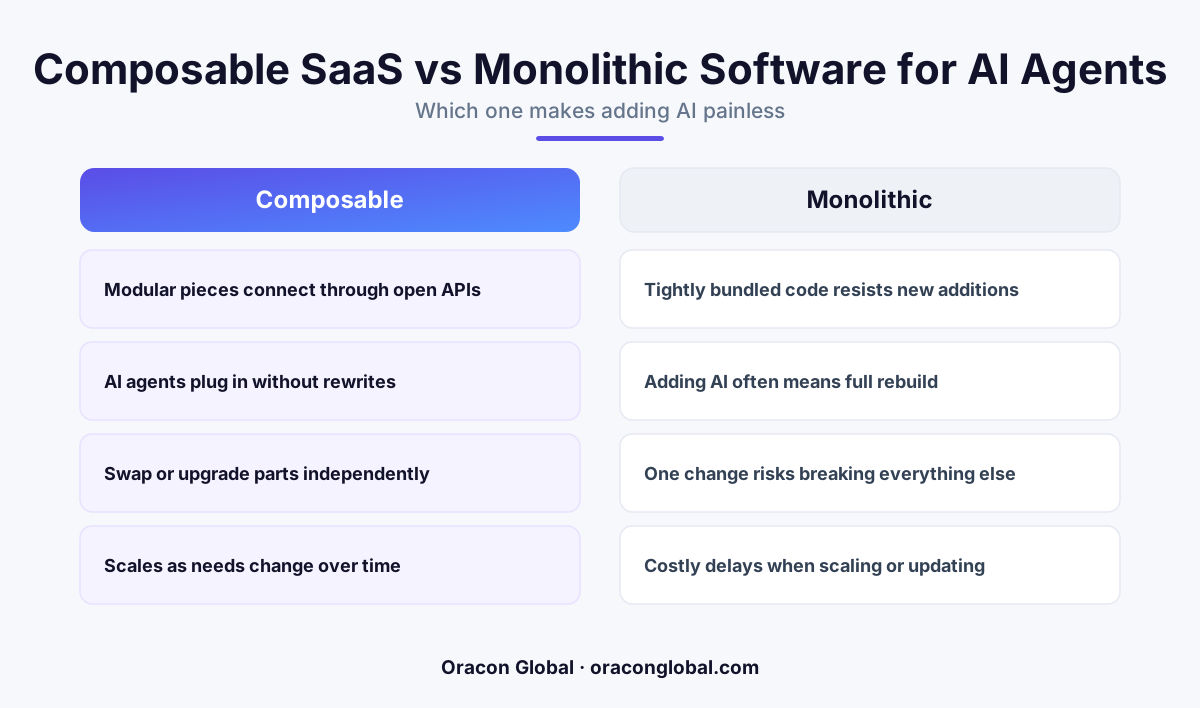
Monolithic software bundles everything into one tightly coupled system, which makes adding AI agents slow and risky later. Composable SaaS breaks the system into independent services with clear APIs, so an AI agent can plug into one part without touching the rest. If you're building or rebuilding software now, designing it to be composable is the cheapest insurance you can buy against your own future AI roadmap.
Most founders don't think about software architecture until the day they try to add an AI agent and discover it can't be done cleanly. The agent needs to read from five systems, write to two, and somehow not break the one feature the whole business depends on. That friction isn't an AI problem. It's an architecture problem, and it was baked in years earlier when the software was built as one big connected block instead of separate, swappable pieces.
This is the real argument for composable SaaS over monolithic software: not that it's trendier, but that it's the only structure flexible enough to absorb AI agents without a rebuild every time you want one.
What "monolithic" actually costs you later
Monolithic software means every function, every database table, every workflow lives inside one tightly wired codebase. It's often faster to build at first. Everything is in one place, so early features ship quickly.
The cost shows up later, when you try to change one part without disturbing the rest. In a monolith:
- A small update to the inventory logic can quietly break reporting or billing, because they share the same code and database.
- Adding a new integration means touching core code that everything else depends on.
- One team's change can take down a feature another team relies on, with no clear boundary between the two.
- Scaling one busy part of the app (say, order processing) means scaling the entire application, even the parts nobody is using.
None of this matters much when your software does one simple job. It becomes a real problem the moment you want an AI agent to act inside that system, because agents need clean, narrow access points. A monolith rarely has them.
What composable architecture gets right
Composable SaaS breaks the same functionality into independent services, each with a clear job and a clear API: billing is its own service, inventory is its own service, notifications are their own service. They talk to each other through defined interfaces instead of shared internal code. This sounds like a technical detail. In practice, it's the difference between an AI agent plugging into one small, well-defined door versus an AI agent needing a master key to the entire building.
Why this matters specifically for AI agents
An AI agent that handles support tickets, updates inventory, or processes refunds needs to call specific actions safely: check a balance, update a status, send a confirmation. It should not need to understand your entire codebase to do that.
In a composable system, you expose exactly the actions the agent is allowed to take, nothing more. In a monolith, giving an agent access often means giving it far more reach than you intended, because the boundaries that would normally contain it don't exist.
A simple way to picture the difference
Think of a monolith as one large room with no internal walls. Everything is accessible from everywhere, which is convenient until you need to let someone new into the room without letting them touch everything in it.
Composable SaaS is the same building with separate rooms, each with its own door and its own key. You can let an AI agent into the "order status" room without ever giving it a key to the "customer payment details" room. That separation isn't bureaucracy. It's what makes AI adoption safe at all.
Where this shows up in real projects
When our team at Oracon Global builds AI-native systems, whether that's an AI agent, an AI digital employee, or an AI-native ERP we've built in-house for a client, the first question is never "which model should we use." It's "what does this system need to see, and what should it never be allowed to touch." That question is only answerable quickly when the underlying software is already composable.
Teams with monolithic systems can still get there. It usually means:
- Mapping the monolith's internal functions and identifying which ones the AI agent genuinely needs.
- Wrapping those specific functions behind a clean API layer, without touching the rest of the codebase.
- Letting the AI agent operate only through that new layer, never directly against the core system.
- Gradually extracting more services out of the monolith as confidence grows, rather than rewriting everything at once.
This is slower than building on composable architecture from day one, but it's far cheaper than the alternative, which is rebuilding the whole system under pressure once an AI rollout stalls.
The founder-level takeaway
If you're building new software today, even if an AI agent isn't on your roadmap yet, design it as composable services with clear APIs between them. It costs a little more planning now and saves a rebuild later. This is true whether you're shipping a customer-facing app, an internal tool, or a full SaaS product.
If you already have a monolith and it's working, you don't need to panic or rebuild it overnight. You need an honest map of what the AI agent actually needs to touch, and a plan to expose only that, safely, through a layer the rest of your system doesn't depend on.
Either way, the decision isn't really about AI. It's about whether your software can change shape as your business does, without a crisis every time it needs to.
If you're weighing whether your current software can support AI agents cleanly, or you're starting a new build and want it architected the right way from day one, talk to the Oracon Global team. You can also try the live AI demos and the Aria assistant on our site to see how this kind of system actually behaves in practice.
Frequently asked questions
What does "composable SaaS" actually mean in plain terms?
It means your software is built as separate, independent pieces (billing, inventory, notifications, user accounts) that talk to each other through clear APIs, instead of one giant codebase where everything is tangled together.
Can I make an existing monolithic system composable without a full rebuild?
Often yes. Many teams wrap key functions behind APIs and gradually extract services, rather than rewriting everything at once. A proper architecture audit will tell you which parts are worth separating first.
Does composable architecture cost more to build initially?
It can take a bit more planning upfront, but it usually saves money over time because you avoid expensive rework every time you add a new feature, integration, or AI agent.
How do I know if my current software is monolithic?
A simple test: if changing one small feature requires touching many unrelated parts of the system, or if you can't update one module without redeploying the whole app, you likely have a monolith.
Read next
Beyond Chatbots: How to Build AI Agents That Actually Do Work for Your Business
Most businesses use AI to answer questions. Here is how to build custom AI agents that actually take action, connect to your internal tools, and handle complex workflows.
Beyond the Wrapper: How to Build Custom AI Agents for Business That Actually Work
Many businesses invest in basic AI wrappers only to find they lack the security and context needed for real work. Here is how to build custom AI agents that integrate deeply with your workflows and databases.
Enterprise AI Maintenance Costs: Budgeting for Year Two and Beyond
Building an AI system is only half the battle. Discover the practical, ongoing operational costs of enterprise AI, including token management, model drift, and continuous security audits.
Oracon Global builds production-grade AI agents, automation and apps — and you own the code and IP. Tell us what you want to automate.
Book a call →See our work