

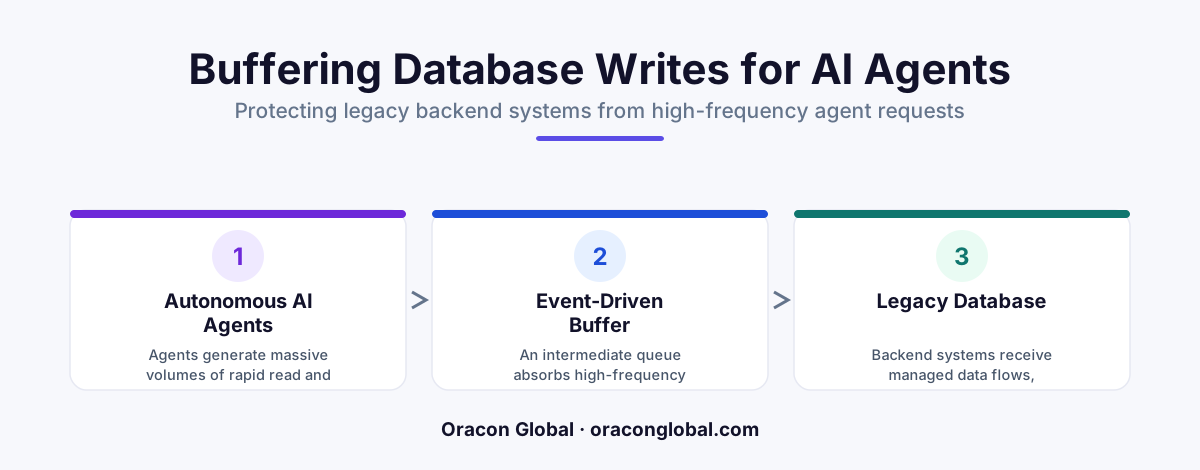
High-volume AI agents generate unstructured parallel queries that trigger row locks, API rate limits, and system timeouts in traditional databases. An event-driven database buffer decouples agent actions from core storage by queuing execution events and writing payloads deterministically. This architecture ensures high operational throughput while maintaining system stability and data accuracy.
Deploying autonomous AI agents into enterprise software environments often uncovers a painful technical reality: traditional database infrastructure was never designed for non-human traffic patterns. When an AI agent runs a multi-step workflow—such as parsing structured data from hundreds of invoices or running real-time inventory adjustments—it generates a massive burst of concurrent database queries. Without an event-driven database buffer, this rapid intake triggers connection pool exhaustion, table locks, and cascaded backend system failure.
For founders and product leaders scaling modern applications, bridging the speed of agentic execution with legacy database stability is critical. Protecting core operational databases requires moving from direct synchronous writes to a buffered, event-driven queue system.
The Hidden Mechanics of Database Lock Contention
Most traditional web applications rely on synchronous database models. A user clicks a button, a web server processes the HTTP request, executes an SQL query, and returns a response. This model works cleanly when transaction volume correlates directly with human typing speed and click rates.
Autonomous agents break this paradigm completely. An agent performing complex business operations does not execute actions linearly. Instead, it fires off parallel tool calls to verify state, fetch context, and write updates. When multiple agents run concurrently, hundreds of read-write operations hit the primary relational database within milliseconds.
This spike creates severe operational bottlenecks:
- Row and Table Locking: Rapid updates to shared tables—such as order statuses or inventory counts—force the database to lock rows, causing subsequent incoming agent requests to queue and eventually time out.
- Connection Pool Depletion: High-frequency agent calls saturate available database connections, starving human users and web frontends of backend access.
- Cascading API Retries: When an agent request times out, built-in retry logic causes the agent to re-send the exact payload, compounding server load and worsening system lockups.
How an Event-Driven Database Buffer Solves the Bottleneck
An event-driven database buffer acts as a shock absorber between your AI agent automation workflows and your transactional storage layer. Instead of allowing agents to write directly to your PostgreSQL, MySQL, or legacy ERP database, all agent-generated actions are transformed into discrete events and ingested into a high-throughput queue.
This decoupling alters how data flows through your application stack, yielding immediate structural advantages:
1. Instant Acknowledgment and Asynchronous Execution
When an agent completes an operational task, it posts the output payload directly to the buffer layer. The buffer instantly records the message, assigns a tracking ID, and releases the agent to continue its execution tree. The actual database commit happens asynchronously in the background at a ingestion rate your database can safely handle.
2. Rate Throttling and Batching
The buffer layer dynamically controls write velocity. Rather than executing 500 individual SQL updates in one second, the queue batches requests into optimized multi-row operations or processes them sequentially based on current database CPU and memory metrics.
3. Idempotency and State Recovery
Network interruptions and API timeouts frequently cause AI agents to resubmit tasks. A robust event-driven buffer uses unique idempotency keys for every queued payload. If an agent submits duplicate operational data, the buffer identifies the key and discards the redundant payload before it ever reaches your production database.
Key Components of a Production-Ready Buffer Architecture
Implementing an effective event-driven queue requires specific architectural safeguards to maintain absolute data integrity across complex AI workflow automation tools.
- Ingestion API Gateway: A lightweight interface designed to ingest incoming payloads instantly, validating JSON schema formatting before appending the event to the queue.
- Persistent Event Log: A durable queue (such as Redis Streams, Apache Kafka, or AWS SQS) that holds state updates on disk, ensuring zero data loss even if the primary database undergoes maintenance.
- Deterministic Consumer Workers: Worker services that consume items from the queue, enforce business logic validation, execute the final database transactions, and handle dead-letter routing for malformed payloads.
- Dead-Letter Queue (DLQ): An isolated storage space where invalid payloads are stored for human evaluation, preventing broken agent outputs from blocking legitimate database updates.
Protecting System Health Without Sacrificing Operational Speed
Founders often worry that adding an asynchronous buffer will slow down user-facing applications. In practice, the opposite occurs. By offloading heavy transactional processing from the primary database thread, overall application response times drop significantly. Front-end users experience zero UI lag, while backend AI workers execute continuous high-volume operations without triggering database downtime or rate limits.
Relying on direct database writes for autonomous workflows introduces compounding technical debt. Installing a tailored event-driven buffer ensures your backend system architecture scales smoothly alongside your business automation needs.
Build Resilient AI Systems with Oracon Global
Building high-volume AI agents, digital employees, and business automation platforms requires deep engineering expertise at both the application and database levels. At Oracon Global, our senior in-house engineering team designs and delivers custom web apps, mobile solutions, and enterprise AI systems engineered for operational stability and speed. Every solution we craft is fully custom, and our clients retain 100% ownership of their IP and source code.
If you are ready to build reliable, high-performance software powered by production-ready AI, explore our live interactive demos on oraconglobal.com or reach out to our engineering team to discuss your project today.
Frequently asked questions
What is an event-driven database buffer?
An event-driven database buffer is an architectural layer that sits between external applications or autonomous AI agents and your primary database, holding inbound write events in a managed queue so they execute safely without causing lock contention or API timeouts.
Why do autonomous AI agents crash legacy databases?
AI agents execute hundreds of parallel tool calls, schema checks, and state updates per second. Legacy databases designed for human web interactions cannot process this volume of concurrent transactions, leading to connection pool exhaustion and table locks.
Will adding a buffer layer introduce unacceptable latency to my application?
No, an event-driven buffer returns instant acknowledgments to the AI agent or front-end user while processing actual database writes asynchronously in milliseconds, significantly reducing perceived latency across your application.
Can an event-driven buffer prevent duplicate data writes?
Yes, modern buffer queues use idempotency keys and state tracking to ensure that even if an AI agent retries a payload due to network noise, the record is only committed to your database once.
Read next
Beyond Chatbots: How to Build AI Agents That Actually Do Work for Your Business
Most businesses use AI to answer questions. Here is how to build custom AI agents that actually take action, connect to your internal tools, and handle complex workflows.
Beyond the Wrapper: How to Build Custom AI Agents for Business That Actually Work
Many businesses invest in basic AI wrappers only to find they lack the security and context needed for real work. Here is how to build custom AI agents that integrate deeply with your workflows and databases.
Enterprise AI Maintenance Costs: Budgeting for Year Two and Beyond
Building an AI system is only half the battle. Discover the practical, ongoing operational costs of enterprise AI, including token management, model drift, and continuous security audits.
Oracon Global builds production-grade AI agents, automation and apps — and you own the code and IP. Tell us what you want to automate.
Book a call →See our work