

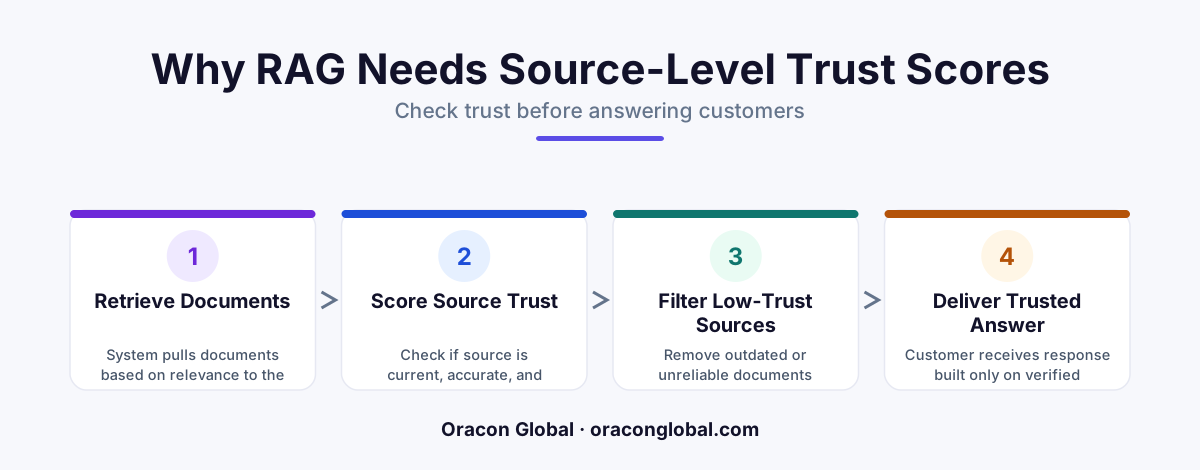
RAG systems usually rank retrieved documents only by how closely they match a query, not by whether the source is current, accurate, or authoritative. Adding a trust score to each document — based on freshness, origin, and conflict with other sources — lets the system downrank or flag shaky content before it reaches a customer. This is a practical, buildable layer, not a theoretical one.
Ask your RAG-powered support agent a question today, and it might confidently quote a pricing page that was retired eight months ago right next to one that's current. The system has no idea it just did that. It retrieved both documents because they matched the query. Nobody ever told it that one of them shouldn't be trusted anymore.
This is the quiet failure mode in most RAG systems built for customer-facing use. They're excellent at finding documents that sound relevant. They're much worse at knowing which of those documents deserve to be believed. That gap is exactly what source-level trust scores are built to close, and it's a layer most teams skip because it doesn't show up in a demo.
Relevance Is Not the Same as Reliability
A typical retrieval-augmented generation setup works like this: a customer asks a question, the system searches a vector database for chunks of text that are semantically similar to that question, and the language model writes an answer using whatever it finds.
That process optimizes for one thing — similarity. It has no built-in concept of whether a document is:
- Current, or quietly outdated by a newer policy change
- Written by someone authorized to speak for the company, or a stray internal draft that never should have been uploaded
- Consistent with other documents, or directly contradicting them
- Verified fact, or a forum post, old email thread, or speculative note someone saved years ago
Feed a RAG system a messy mix of sources — which is what most real knowledge bases are — and it will cheerfully retrieve the wrong one with the same confidence as the right one. The model doesn't hedge. It just answers.
What a Trust Score Actually Does
A source-level trust score is a number attached to each document or chunk during ingestion, separate from the relevance score calculated at query time. Instead of asking "does this match the question," the system also asks "how much should I trust this if it does match."
When a customer question comes in, the retrieval step then weighs both signals together. A highly relevant document with a low trust score can be downranked, flagged for human review, or excluded from the answer entirely. A document with high trust and high relevance gets prioritized and can be cited with more confidence.
What Feeds the Score
In practice, a trust score is built from a combination of factors that are specific to how your business actually produces and manages documents. Common inputs include:
- Recency — when the document was last updated, and whether it belongs to a category that changes often, like pricing or policy
- Source authority — whether it came from an official knowledge base, a verified team, or an unmoderated internal channel
- Conflict detection — whether another, more recent document says something different about the same topic
- Usage history — whether this document has previously led to flagged or corrected answers
- Review status — whether a human has signed off on it as accurate, versus it being auto-ingested and never checked
None of this requires exotic technology. It requires someone deciding, deliberately, what "trustworthy" means for your specific business, and building that logic into the ingestion pipeline instead of hoping the model figures it out on its own.
Where This Actually Bites Teams
The cases where this matters most are rarely dramatic. They're small, quiet, and expensive in a different way — the kind that erode customer trust one wrong answer at a time.
A support agent tells a customer their return window is 30 days because that's what an old PDF said, while the live policy page says 14. A sales assistant quotes a discontinued feature because the marketing deck describing it was never removed from the knowledge base. An internal AI tool cites a compliance rule that was updated last quarter, because the updated version lives in a different folder the system never learned to prefer.
In every one of these cases, the retrieval worked exactly as designed. The documents were relevant. They were also wrong, or at least no longer the right answer — and nothing in the system was built to notice the difference.
Building Trust Scoring Without Overengineering It
This doesn't need to become a research project. A practical rollout usually looks like this:
- Audit your knowledge base and sort documents into rough tiers — official and reviewed, internal but unreviewed, and legacy or uncertain
- Attach a basic trust score to each tier as a starting point, then refine it as you learn where answers go wrong
- Set a threshold below which the system either excludes a source, lowers its confidence in the answer, or routes the question to a human
- Build in a lightweight feedback loop so flagged or corrected answers quietly adjust the trust score of the source document over time
The goal isn't a perfect score. It's a system that knows the difference between "I found something that matches" and "I found something I should actually say out loud to a customer."
Confidence Should Be Earned, Not Assumed
A RAG system that answers every question with the same tone of certainty, regardless of what it pulled from, isn't actually more capable — it's just less honest about its limits. Source-level trust scoring is what lets a system say, in effect, "I'm confident about this one" and "I should check with a human on that one," which is exactly the distinction a good employee makes instinctively.
We build this kind of grounding into the RAG and AI agent systems we deliver at Oracon Global, alongside the live demos you can try on our site, including Aria, our own assistant. Our in-house team handles the full build — ingestion, trust logic, retrieval, and the guardrails around it — and you keep full ownership of the code.
If your AI tools are answering questions with more confidence than your source documents deserve, it's worth a conversation. Get in touch with Oracon Global and we'll walk through what a trust layer would look like for your actual knowledge base.
Frequently asked questions
What is a source-level trust score in a RAG system?
It's a rating applied to each document or chunk in your knowledge base that reflects how reliable, current, and authoritative that source is, used alongside relevance scoring when the system decides what to retrieve and how confidently to answer.
Isn't relevance ranking in RAG already enough?
No. Relevance measures how closely a document matches the question's wording or meaning. It says nothing about whether that document is outdated, contradicted elsewhere, or came from an unreliable source. A highly relevant but wrong document is still wrong.
Does adding trust scoring slow down response time?
Not meaningfully. Trust scores are usually pre-calculated and attached to documents during ingestion, not computed live during a customer query, so retrieval speed stays the same.
Can trust scoring stop every hallucination?
It significantly reduces the most common cause of bad answers — pulling from stale or low-quality sources — but it should be paired with other grounding practices like citation and confidence thresholds for full coverage.
Read next
Beyond Chatbots: How to Build AI Agents That Actually Do Work for Your Business
Most businesses use AI to answer questions. Here is how to build custom AI agents that actually take action, connect to your internal tools, and handle complex workflows.
Beyond the Wrapper: How to Build Custom AI Agents for Business That Actually Work
Many businesses invest in basic AI wrappers only to find they lack the security and context needed for real work. Here is how to build custom AI agents that integrate deeply with your workflows and databases.
Enterprise AI Maintenance Costs: Budgeting for Year Two and Beyond
Building an AI system is only half the battle. Discover the practical, ongoing operational costs of enterprise AI, including token management, model drift, and continuous security audits.
Oracon Global builds production-grade AI agents, automation and apps — and you own the code and IP. Tell us what you want to automate.
Book a call →See our work